
 https://minutescrypto.com/wp-content/uploads/2026/05/ChatGPT-Image-May-5-2026-08_09_26-PM.png
1024
1536
Minutes Crypto
https://minutescrypto.com/wp-content/uploads/2026/05/logo-1-1030x548.png
Minutes Crypto2026-05-05 18:11:132026-05-05 18:11:13💠 What Can Happen to a Token?
https://minutescrypto.com/wp-content/uploads/2026/05/ChatGPT-Image-May-5-2026-08_09_26-PM.png
1024
1536
Minutes Crypto
https://minutescrypto.com/wp-content/uploads/2026/05/logo-1-1030x548.png
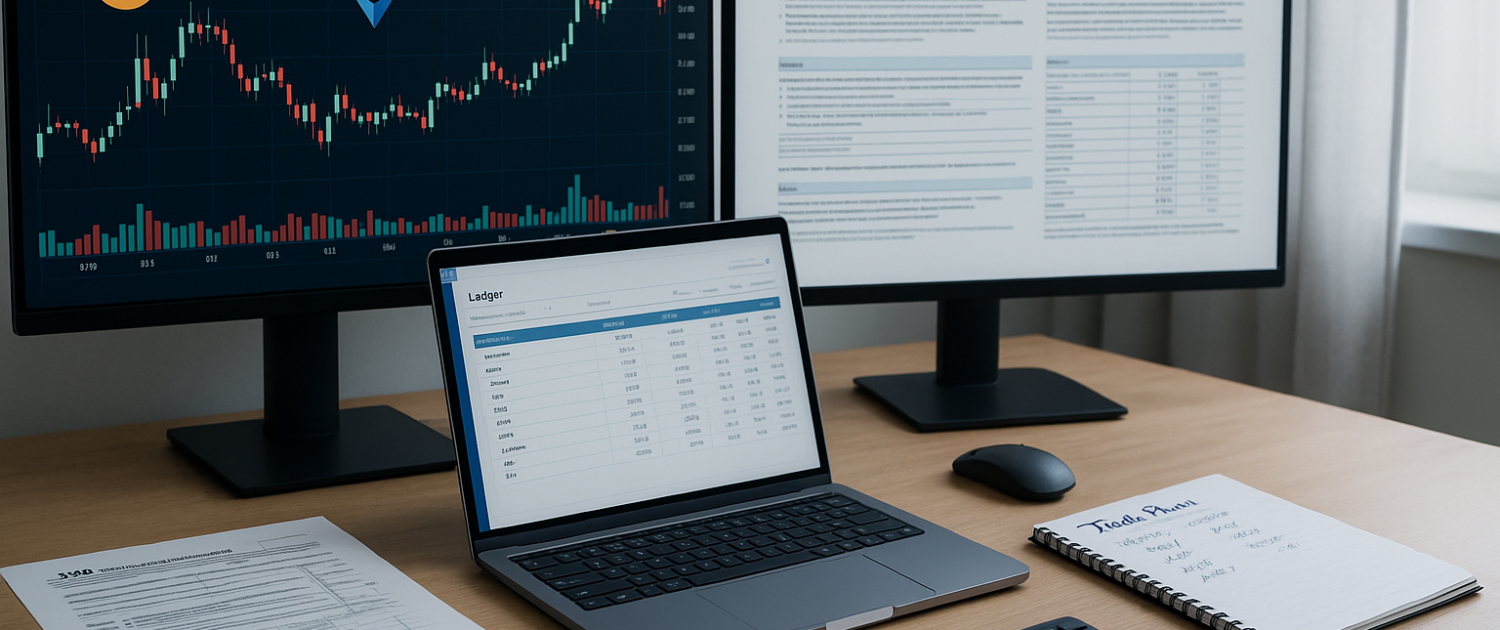
Minutes Crypto2026-05-05 18:11:132026-05-05 18:11:13💠 What Can Happen to a Token?💠 Avoiding IRS Trouble: How to Report Crypto Trading Like a Business
For Businesses, Active Traders, and the General Public
🚀 1. Overview: When Does Crypto Trading Become a “Business”?
Not everyone who buys and sells cryptocurrency is considered a business trader.
The IRS distinguishes between:
- Investors, who hold crypto for long-term appreciation, and
- Traders, who buy and sell frequently with the primary goal of short-term profits.
👉 Frequent trading alone doesn’t qualify your activity as a business.
What matters is intent, organization, and regularity — the same principles that define a trade or business under Commissioner v. Groetzinger, 480 U.S. 23 (1987).
💼 2. Investor vs. Trader: Understanding the IRS View
| Criteria | Investor | Trader (Business Activity) |
| Purpose | Long-term holding for appreciation | Short-term profit from frequent trades |
| Trading volume | Occasional transactions | Continuous, high-volume activity |
| Records & systems | Basic logs for tax basis | Detailed accounting ledger, separate business accounts |
| Entity structure | Usually individual | May use LLC, S-Corp, or partnership |
| Tax treatment | Capital gains/losses | Ordinary income/loss if § 475(f) elected |
| Expense deductions | ❌ Investment expenses under § 212 permanently disallowed under § 67(g) | ✅ Full § 162 business deductions |
💡 Key takeaway:
Investors can no longer deduct advisory, management, or research expenses. Only those who qualify as traders in a trade or business (under § 162 and Groetzinger) may deduct trading expenses.
🧾 3. IRS Guidelines: What Counts as “Carrying On a Business”?
The IRS evaluates trading activity under the same principles as any trade or consulting business.
Key indicators include:
✅ Profit motive – Are you trading primarily to earn income?
✅ Business-like conduct – Do you operate through a structured plan and maintain detailed records?
✅ Regularity and continuity – Is your trading frequent and organized?
✅ Capital and scale – Have you invested significant time, capital, and tools?
✅ Entity operation – Do you operate through a company (LLC, S-Corp, etc.)?
💼 Proper accounting systems matter.
Maintaining a professional ledger or accounting system—such as that offered by MinutesCrypto.com—is an important indicator that trading activity is organized and conducted as a business.
A complete accounting record of trades, realized and unrealized gains, related expenses, and supporting documentation helps demonstrate the “business-like conduct” required under Groetzinger.
The IRS considers such records strong evidence when determining whether trading qualifies as a trade or business under IRC § 162, allowing business expense deductions.
⚠️ The IRS closely reviews traders who claim business deductions without meeting the trade-or-business threshold. Misclassification can lead to penalties and amended returns.
💵 4. Tax Treatment: Investor vs. Trader
🪙 For Investors
- Crypto = property (IRS Notice 2014-21).
- Capital gain = selling price – purchase price (+ transaction costs).
- Short-term (< 1 year): taxed as ordinary income (up to 37%).
- Long-term (> 1 year): taxed at 0%, 15%, or 20%.
- Investment expenses: Permanently disallowed under § 67(g) after the 2025 Act.
- Only direct costs (exchange fees, gas fees) adjust basis.
- Advisory, management, or subscription fees are no longer deductible.
Example:
Buy 2 ETH for $4,000 → sell for $6,000 → $2,000 capital gain taxed at capital-gain rates.
💹 For Business Traders
If your trading qualifies as a trade or business under § 162:
- You may deduct ordinary and necessary expenses, such as:
- Trading platform fees
- Internet, software, research tools
- Office rent or home-office allocation
- Professional advisers (W-2 or 1099 for trading strategy services)
- Trading platform fees
- Without § 475(f): Gains/losses remain capital, but expenses are deductible as § 162 business expenses (if trader status met).
With § 475(f): Gains/losses become ordinary (mark-to-market); losses fully deductible; no capital-loss limitation.
💡 5. Why Consider a § 475(f) Election?
Even when business expenses are already deductible under § 162, the § 475(f) mark-to-market election provides unique benefits:
Advantages
- Converts capital gains/losses to ordinary.
- Removes the $3,000 capital-loss limitation.
- Allows immediate deduction of full losses.
- Eliminates wash-sale complications (for securities — crypto already exempt).
Trade-offs
- Year-end mark-to-market taxes unrealized gains.
- Loses preferential long-term rates.
- Hard to revoke (usually five-year lock-in).
- Only applies to “securities” or “commodities” under § 475(c) & (e).
🧮 Eligibility of Crypto for § 475(f) Election
To make a valid § 475(f) election, the assets traded must qualify as either “securities” or “commodities” under the Internal Revenue Code. Although the Commodity Futures Trading Commission (CFTC) has classified Bitcoin and Ether as commodities, the IRS has not formally confirmed that spot crypto constitutes a “commodity” (or “security”) for § 475 purposes.
Thus, while CME-traded Bitcoin and Ether futures clearly qualify (since they trade on a CFTC-registered exchange), spot crypto traded on retail platforms (e.g., Coinbase, Kraken) does not yet meet the definition of an “actively traded commodity” under § 1092(d)(1).
A crypto trader could argue eligibility for § 475(f), but doing so involves interpretive risk until the IRS or Treasury issues formal guidance. Consultation with a qualified tax professional is essential before electing § 475(f) for crypto assets.
⚙️ 6. Recordkeeping & Compliance Tips
Maintain:
- Each buy, sell, swap, conversion (with timestamps)
- Transaction fees and wallet addresses
- Receipts for expenses and equipment
- Copies of trading plans or algorithms
- Year-end mark-to-market adjustments (if elected)
Good records are your best defense in an audit.
🌐 7. Grey Areas: DeFi, Staking, and Yield Farming
Until further IRS guidance:
- Treat staking rewards, liquidity pool, and yield income as ordinary income when received.
- Keep records by protocol and wallet.
- Each crypto-to-crypto swap is a taxable event.
🧭 8. Practical Recommendations
- Seek professional tax advice before electing § 475(f).
- Do not assume non-cash swaps are tax-free — they aren’t.
- Stay current on IRS digital asset reporting (Form 1099-DA) and broker rules.
- File accurately — misreporting crypto can trigger civil or criminal penalties.
🧩 9. Summary Snapshot
| Scenario | Likely IRS Treatment | Tax Form |
| Casual crypto investor | Capital gains | Form 8949 + Schedule D |
| Active trader (no § 475)** | Capital gains + business expenses (if TTS met) | Form 8949 + Schedule D + C |
| Trader with § 475(f)** | Ordinary income/loss (MTM) | Schedule C or Form 1120 |
| Staking or DeFi income | Ordinary income | Schedule 1 or C |
| Mining activity | Business or self-employment income | Schedule C + SE tax |
⚖️ 10. Final Word
The IRS does not set a numeric threshold for when trading becomes a business.
It evaluates facts and circumstances — frequency, intent, organization, and recordkeeping.
Being structured, organized, and transparent (with a proper accounting system like MinutesCrypto.com) helps demonstrate legitimacy and reduce audit risk.
💬 Trade smart — and trade compliant.
We welcome your feedback, questions and ideas, comment below or email us at hello@minutescrypto.com.
Interested in crypto accounting? Minutes Crypto Calculator serves as a comprehensive digital asset tax and accounting system, providing automated transaction classification, real-time portfolio tracking, and precise capital gains and losses reporting.
We are also opening two opportunities:
• The First One Hundred Impactful Users Program
Be among the first one hundred users who help shape the future of Minutes. You’ll receive early feature access, direct influence on the product roadmap, and priority support as we refine the platform for professionals and everyday investors.
• Upcoming Professional Seminars on the New Crypto Rules
We will soon be hosting seminars that break down the latest IRS and global crypto regulatory changes for accountants, tax experts, finance teams and crypto-active professionals. Everyone is welcome. If you’d like to attend, simply sign up so we know you’re interested.
📚 Authorities & References
- IRC § 162 – Trade or Business Expenses
→ Governs deductibility of expenses for active trading businesses. - IRC § 475(f) – Election of Traders to Use Mark-to-Market Accounting
→ Allows qualifying traders in securities or commodities to treat gains/losses as ordinary income. - IRC § 67(g) (as amended by 2025 Act)** – Permanent Disallowance of § 212 Investment Expenses**
→ Confirms that non-business investment expenses are permanently nondeductible. - IRS Notice 2014-21 – Virtual Currency Treated as Property
→ Establishes that digital assets like Bitcoin are treated as property for federal tax purposes.
- Commissioner v. Groetzinger, 480 U.S. 23 (1987)
→ Defines “trade or business” as activity conducted regularly, continuously, and with a profit motive.
✅ Note:
This summary reflects federal tax law and guidance as of November 2025.
Disclaimer
The information provided in this article is for general informational purposes only and does not constitute legal, accounting, or tax advice. Tax laws are complex and subject to change, and individual circumstances may vary, often resulting in different tax outcomes than those described under general rules. Readers are strongly encouraged to consult a qualified tax professional or advisor to obtain advice specific to their personal situation. The author and publisher assume no responsibility for any errors, omissions, or outcomes resulting from the use of this information.
https://minutescrypto.com/wp-content/uploads/2026/05/ChatGPT-Image-May-5-2026-08_09_26-PM.png
1024
1536
Minutes Crypto
https://minutescrypto.com/wp-content/uploads/2026/05/logo-1-1030x548.png
Minutes Crypto2026-05-05 18:11:132026-05-05 18:11:13💠 What Can Happen to a Token? https://minutescrypto.com/wp-content/uploads/2026/05/ChatGPT-Image-May-5-2026-07_14_41-PM.png
1024
1536
Minutes Crypto
https://minutescrypto.com/wp-content/uploads/2026/05/logo-1-1030x548.png
Minutes Crypto2026-04-20 09:22:132026-05-05 17:27:19The Tax Trigger
https://minutescrypto.com/wp-content/uploads/2026/05/ChatGPT-Image-May-5-2026-07_14_41-PM.png
1024
1536
Minutes Crypto
https://minutescrypto.com/wp-content/uploads/2026/05/logo-1-1030x548.png
Minutes Crypto2026-04-20 09:22:132026-05-05 17:27:19The Tax Trigger https://minutescrypto.com/wp-content/uploads/2026/05/ChatGPT-Image-May-5-2026-06_26_06-PM.png
1024
1536
Minutes Crypto
https://minutescrypto.com/wp-content/uploads/2026/05/logo-1-1030x548.png
Minutes Crypto2026-04-13 09:29:262026-05-05 16:43:09💠 Crypto Migrations
https://minutescrypto.com/wp-content/uploads/2026/05/ChatGPT-Image-May-5-2026-06_26_06-PM.png
1024
1536
Minutes Crypto
https://minutescrypto.com/wp-content/uploads/2026/05/logo-1-1030x548.png
Minutes Crypto2026-04-13 09:29:262026-05-05 16:43:09💠 Crypto Migrations https://minutescrypto.com/wp-content/uploads/2025/11/ChatGPT-Image-Nov-26-2025-04_28_30-PM.png
1024
1536
Minutes Crypto
https://minutescrypto.com/wp-content/uploads/2026/05/logo-1-1030x548.png
Minutes Crypto2025-11-26 14:30:222025-11-27 14:59:31How to Handle DeFi Taxes in 2025
https://minutescrypto.com/wp-content/uploads/2025/11/ChatGPT-Image-Nov-26-2025-04_28_30-PM.png
1024
1536
Minutes Crypto
https://minutescrypto.com/wp-content/uploads/2026/05/logo-1-1030x548.png
Minutes Crypto2025-11-26 14:30:222025-11-27 14:59:31How to Handle DeFi Taxes in 2025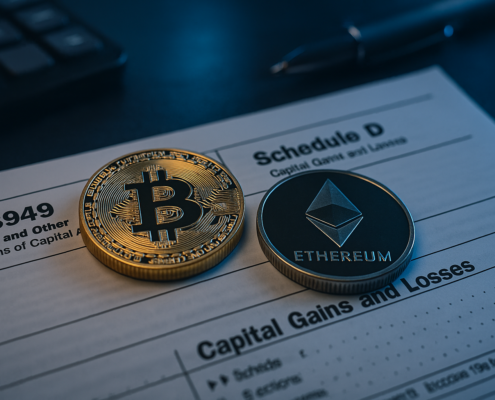 https://minutescrypto.com/wp-content/uploads/2025/11/ChatGPT-Image-Nov-24-2025-11_05_04-AM.png
1024
1536
Minutes Crypto
https://minutescrypto.com/wp-content/uploads/2026/05/logo-1-1030x548.png
Minutes Crypto2025-11-24 09:07:022025-11-26 12:14:13💰 Crypto Losses, Tax Gains: 2025 Edition
https://minutescrypto.com/wp-content/uploads/2025/11/ChatGPT-Image-Nov-24-2025-11_05_04-AM.png
1024
1536
Minutes Crypto
https://minutescrypto.com/wp-content/uploads/2026/05/logo-1-1030x548.png
Minutes Crypto2025-11-24 09:07:022025-11-26 12:14:13💰 Crypto Losses, Tax Gains: 2025 Edition https://minutescrypto.com/wp-content/uploads/2025/11/ChatGPT-Image-Nov-21-2025-at-10_00_09-AM.png
1024
1536
Minutes Crypto
https://minutescrypto.com/wp-content/uploads/2026/05/logo-1-1030x548.png
Minutes Crypto2025-11-21 08:03:082025-11-26 12:17:03Crypto Loss Harvesting & 2025 Basis Rules — A Simple Guide
https://minutescrypto.com/wp-content/uploads/2025/11/ChatGPT-Image-Nov-21-2025-at-10_00_09-AM.png
1024
1536
Minutes Crypto
https://minutescrypto.com/wp-content/uploads/2026/05/logo-1-1030x548.png
Minutes Crypto2025-11-21 08:03:082025-11-26 12:17:03Crypto Loss Harvesting & 2025 Basis Rules — A Simple Guide https://minutescrypto.com/wp-content/uploads/2025/11/ChatGPT-Image-Nov-20-2025-at-04_48_22-PM.png
1024
1536
Minutes Crypto
https://minutescrypto.com/wp-content/uploads/2026/05/logo-1-1030x548.png
Minutes Crypto2025-11-20 14:51:372025-11-26 12:17:56DeFi Liquidity Taxes Explained
https://minutescrypto.com/wp-content/uploads/2025/11/ChatGPT-Image-Nov-20-2025-at-04_48_22-PM.png
1024
1536
Minutes Crypto
https://minutescrypto.com/wp-content/uploads/2026/05/logo-1-1030x548.png
Minutes Crypto2025-11-20 14:51:372025-11-26 12:17:56DeFi Liquidity Taxes Explained https://minutescrypto.com/wp-content/uploads/2025/11/ChatGPT-Image-Nov-17-2025-05_15_22-PM.png
1024
1536
Minutes Crypto
https://minutescrypto.com/wp-content/uploads/2026/05/logo-1-1030x548.png
Minutes Crypto2025-11-17 15:17:512025-11-26 12:18:22Navigating Bitcoin Taxes in 2025: Federal, NIIT, and State Rules Simplified
https://minutescrypto.com/wp-content/uploads/2025/11/ChatGPT-Image-Nov-17-2025-05_15_22-PM.png
1024
1536
Minutes Crypto
https://minutescrypto.com/wp-content/uploads/2026/05/logo-1-1030x548.png
Minutes Crypto2025-11-17 15:17:512025-11-26 12:18:22Navigating Bitcoin Taxes in 2025: Federal, NIIT, and State Rules Simplified https://minutescrypto.com/wp-content/uploads/2025/11/ChatGPT-Image-Nov-14-2025-09_45_10-AM.png
1024
1536
Minutes Crypto
https://minutescrypto.com/wp-content/uploads/2026/05/logo-1-1030x548.png
Minutes Crypto2025-11-14 07:53:342025-11-26 12:27:54How to Report Crypto Trading Like a Business
https://minutescrypto.com/wp-content/uploads/2025/11/ChatGPT-Image-Nov-14-2025-09_45_10-AM.png
1024
1536
Minutes Crypto
https://minutescrypto.com/wp-content/uploads/2026/05/logo-1-1030x548.png
Minutes Crypto2025-11-14 07:53:342025-11-26 12:27:54How to Report Crypto Trading Like a Business


Leave a Reply
Want to join the discussion?Feel free to contribute!