

 https://minutescrypto.com/wp-content/uploads/2026/05/ChatGPT-Image-May-5-2026-08_09_26-PM.png
1024
1536
Minutes Crypto
https://minutescrypto.com/wp-content/uploads/2026/05/logo-1-1030x548.png
Minutes Crypto2026-05-05 18:11:132026-05-05 18:11:13💠 What Can Happen to a Token?
https://minutescrypto.com/wp-content/uploads/2026/05/ChatGPT-Image-May-5-2026-08_09_26-PM.png
1024
1536
Minutes Crypto
https://minutescrypto.com/wp-content/uploads/2026/05/logo-1-1030x548.png
Minutes Crypto2026-05-05 18:11:132026-05-05 18:11:13💠 What Can Happen to a Token?💰 Crypto Basis Rules Are Changing, What You Need to Know for 2025 & Beyond
✅ What Stays the Same
🪙 Crypto = Property, Not Currency
For U.S. federal tax purposes, digital assets remain property, not money.
Sales, swaps, or spending trigger capital gain or loss—just like stocks or real estate.
📈 Gain or Loss = Sale Price − Cost Basis
Every time you dispose of crypto, you compute:
Amount realized − Cost basis = Taxable gain (or loss)
⏱️ Holding Period Still Controls Tax Rate
Hold for ≤ 1 year → Short-term (ordinary rates)
Hold for > 1 year → Long-term (capital-gains rates)
Holding periods carry over through non-taxable transfers between your own wallets or accounts.
⚠️ What’s Changing (Effective 2025 Onward)
🧩 1. Per-“Wallet” / Per-Broker Account Basis Tracking
Starting January 1, 2025, cost basis must be tracked separately for each wallet or broker account—no more “universal pooling.”
You must identify which units were sold within that specific “wallet” or broker account.
Transfers between “wallets” are nonrecognition events—basis and holding period travel with the assets. FIFO (First-In, First-Out) applies within each wallet/account unless you make a timely Specific Identification.
Regulatory Definition of “Wallet”:
In the preamble to the final regulations (T.D. 9990, Section III.C.3), the IRS clarifies: “A wallet means a set of digital asset addresses or private keys, or accounts, that a person treats as a single unit for recordkeeping purposes.”
This definition makes clear that a “wallet” is an accounting construct, not a specific blockchain address or app.
💡 Safe Harbor – Rev. Proc. 2024-28
If you used universal pooling before 2025, you may re-allocate pre-2025 “unused basis” among your wallets/accounts:
- Do it once, before your first 2025 sale or your 2025 return due date.
- Basis and holding periods move together.
- Document how and when you completed the allocation.
(This step transitions your records into the new “wallet-by-wallet” model.)
🧾 2. New Broker Reporting — Form 1099-DA
| Year | What’s Reported | Who Reports It |
| 2025 onward | Gross proceeds from digital-asset sales/exchanges | Brokers, exchanges, custodial wallet providers |
| 2026 onward | Cost basis + gain/loss info | Same filers |
These rules mirror stock brokerage reporting.
Expect tighter IRS matching and greater emphasis on your own basis records.
🧾 3. Documentation & Lot Identification Matter More Than Ever
To use Specific Identification, you must keep contemporaneous, verifiable records:
🗓 Date / time acquired and sold
💵 Cost basis and FMV in USD
🔐 Wallet or account where held
📜 Transaction fees and disposition details
If you cannot produce this documentation, IRS rules default you to FIFO, which can increase taxable gain. (Notice 2025-7 also allows temporary flexibility in 2025 if brokers cannot yet process your standing instructions.)
🧮 What This Means for You
🏦 1. Plan for Per-“Wallet” Ledgers
Set up a cost-basis ledger for each exchange or “wallet” you use.
- Each exchange account = its own “account.”
- All self-custody holdings may be treated as one “wallet” (or more, if you track separately).
➡️ The “wallets” in the regulations are accounting concepts referring to groupings of holdings for basis tracking purposes.
To avoid confusion, in the Minutes accounting ledger, we call these Basis Buckets.
🛡 2. Use the Safe Harbor Before 2025
Reallocate your unused basis by Dec 31, 2024 (or before your first 2025 sale).
This locks in compliant starting balances under the new rules.
📚 3. Maintain Granular Records
Record every acquisition, transfer, and sale:
Date / Time | Cost Basis (USD) | Wallet / Account | Disposition Details | Fees
📑 4. Verify Broker 1099-DA Data
When Forms 1099-DA arrive (2025–26), reconcile:
- Reported gross proceeds
- Reported basis
- Your own internal records
🔁 5. Document Transfers Between Wallets or Exchanges
Transfers are not taxable, but you must log them:
“2024-11-15 – Transferred 0.5 BTC from Private Wallet to Exchange A – Carryover basis $15,000, acq. date 2022-07-01.”
This ensures continuity of both basis and holding period.
We welcome your feedback, questions and ideas, comment below or email us at hello@minutescrypto.com.
Interested in crypto accounting? Minutes Crypto Calculator serves as a comprehensive digital asset tax and accounting system, providing automated transaction classification, real-time portfolio tracking, and precise capital gains and losses reporting.
We are also opening two opportunities:
• The First One Hundred Impactful Users Program
Be among the first one hundred users who help shape the future of Minutes. You’ll receive early feature access, direct influence on the product roadmap, and priority support as we refine the platform for professionals and everyday investors.
• Upcoming Professional Seminars on the New Crypto Rules
We will soon be hosting seminars that break down the latest IRS and global crypto regulatory changes for accountants, tax experts, finance teams and crypto-active professionals. Everyone is welcome. If you’d like to attend, simply sign up so we know you’re interested.
Disclaimer
The information provided in this article is for general informational purposes only and does not constitute legal, accounting, or tax advice. Tax laws are complex and subject to change, and individual circumstances may vary, often resulting in different tax outcomes than those described under general rules. Readers are strongly encouraged to consult a qualified tax professional or advisor to obtain advice specific to their personal situation. The author and publisher assume no responsibility for any errors, omissions, or outcomes resulting from the use of this information.
https://minutescrypto.com/wp-content/uploads/2026/05/ChatGPT-Image-May-5-2026-08_09_26-PM.png
1024
1536
Minutes Crypto
https://minutescrypto.com/wp-content/uploads/2026/05/logo-1-1030x548.png
Minutes Crypto2026-05-05 18:11:132026-05-05 18:11:13💠 What Can Happen to a Token? https://minutescrypto.com/wp-content/uploads/2026/05/ChatGPT-Image-May-5-2026-07_14_41-PM.png
1024
1536
Minutes Crypto
https://minutescrypto.com/wp-content/uploads/2026/05/logo-1-1030x548.png
Minutes Crypto2026-04-20 09:22:132026-05-05 17:27:19The Tax Trigger
https://minutescrypto.com/wp-content/uploads/2026/05/ChatGPT-Image-May-5-2026-07_14_41-PM.png
1024
1536
Minutes Crypto
https://minutescrypto.com/wp-content/uploads/2026/05/logo-1-1030x548.png
Minutes Crypto2026-04-20 09:22:132026-05-05 17:27:19The Tax Trigger https://minutescrypto.com/wp-content/uploads/2026/05/ChatGPT-Image-May-5-2026-06_26_06-PM.png
1024
1536
Minutes Crypto
https://minutescrypto.com/wp-content/uploads/2026/05/logo-1-1030x548.png
Minutes Crypto2026-04-13 09:29:262026-05-05 16:43:09💠 Crypto Migrations
https://minutescrypto.com/wp-content/uploads/2026/05/ChatGPT-Image-May-5-2026-06_26_06-PM.png
1024
1536
Minutes Crypto
https://minutescrypto.com/wp-content/uploads/2026/05/logo-1-1030x548.png
Minutes Crypto2026-04-13 09:29:262026-05-05 16:43:09💠 Crypto Migrations https://minutescrypto.com/wp-content/uploads/2025/11/ChatGPT-Image-Nov-26-2025-04_28_30-PM.png
1024
1536
Minutes Crypto
https://minutescrypto.com/wp-content/uploads/2026/05/logo-1-1030x548.png
Minutes Crypto2025-11-26 14:30:222025-11-27 14:59:31How to Handle DeFi Taxes in 2025
https://minutescrypto.com/wp-content/uploads/2025/11/ChatGPT-Image-Nov-26-2025-04_28_30-PM.png
1024
1536
Minutes Crypto
https://minutescrypto.com/wp-content/uploads/2026/05/logo-1-1030x548.png
Minutes Crypto2025-11-26 14:30:222025-11-27 14:59:31How to Handle DeFi Taxes in 2025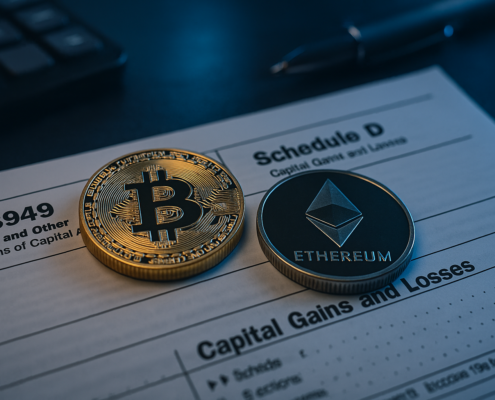 https://minutescrypto.com/wp-content/uploads/2025/11/ChatGPT-Image-Nov-24-2025-11_05_04-AM.png
1024
1536
Minutes Crypto
https://minutescrypto.com/wp-content/uploads/2026/05/logo-1-1030x548.png
Minutes Crypto2025-11-24 09:07:022025-11-26 12:14:13💰 Crypto Losses, Tax Gains: 2025 Edition
https://minutescrypto.com/wp-content/uploads/2025/11/ChatGPT-Image-Nov-24-2025-11_05_04-AM.png
1024
1536
Minutes Crypto
https://minutescrypto.com/wp-content/uploads/2026/05/logo-1-1030x548.png
Minutes Crypto2025-11-24 09:07:022025-11-26 12:14:13💰 Crypto Losses, Tax Gains: 2025 Edition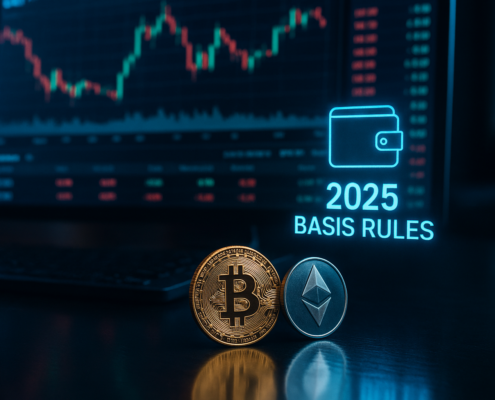 https://minutescrypto.com/wp-content/uploads/2025/11/ChatGPT-Image-Nov-21-2025-at-10_00_09-AM.png
1024
1536
Minutes Crypto
https://minutescrypto.com/wp-content/uploads/2026/05/logo-1-1030x548.png
Minutes Crypto2025-11-21 08:03:082025-11-26 12:17:03Crypto Loss Harvesting & 2025 Basis Rules — A Simple Guide
https://minutescrypto.com/wp-content/uploads/2025/11/ChatGPT-Image-Nov-21-2025-at-10_00_09-AM.png
1024
1536
Minutes Crypto
https://minutescrypto.com/wp-content/uploads/2026/05/logo-1-1030x548.png
Minutes Crypto2025-11-21 08:03:082025-11-26 12:17:03Crypto Loss Harvesting & 2025 Basis Rules — A Simple Guide https://minutescrypto.com/wp-content/uploads/2025/11/ChatGPT-Image-Nov-20-2025-at-04_48_22-PM.png
1024
1536
Minutes Crypto
https://minutescrypto.com/wp-content/uploads/2026/05/logo-1-1030x548.png
Minutes Crypto2025-11-20 14:51:372025-11-26 12:17:56DeFi Liquidity Taxes Explained
https://minutescrypto.com/wp-content/uploads/2025/11/ChatGPT-Image-Nov-20-2025-at-04_48_22-PM.png
1024
1536
Minutes Crypto
https://minutescrypto.com/wp-content/uploads/2026/05/logo-1-1030x548.png
Minutes Crypto2025-11-20 14:51:372025-11-26 12:17:56DeFi Liquidity Taxes Explained https://minutescrypto.com/wp-content/uploads/2025/11/ChatGPT-Image-Nov-17-2025-05_15_22-PM.png
1024
1536
Minutes Crypto
https://minutescrypto.com/wp-content/uploads/2026/05/logo-1-1030x548.png
Minutes Crypto2025-11-17 15:17:512025-11-26 12:18:22Navigating Bitcoin Taxes in 2025: Federal, NIIT, and State Rules Simplified
https://minutescrypto.com/wp-content/uploads/2025/11/ChatGPT-Image-Nov-17-2025-05_15_22-PM.png
1024
1536
Minutes Crypto
https://minutescrypto.com/wp-content/uploads/2026/05/logo-1-1030x548.png
Minutes Crypto2025-11-17 15:17:512025-11-26 12:18:22Navigating Bitcoin Taxes in 2025: Federal, NIIT, and State Rules Simplified https://minutescrypto.com/wp-content/uploads/2025/11/ChatGPT-Image-Nov-14-2025-09_45_10-AM.png
1024
1536
Minutes Crypto
https://minutescrypto.com/wp-content/uploads/2026/05/logo-1-1030x548.png
Minutes Crypto2025-11-14 07:53:342025-11-26 12:27:54How to Report Crypto Trading Like a Business
https://minutescrypto.com/wp-content/uploads/2025/11/ChatGPT-Image-Nov-14-2025-09_45_10-AM.png
1024
1536
Minutes Crypto
https://minutescrypto.com/wp-content/uploads/2026/05/logo-1-1030x548.png
Minutes Crypto2025-11-14 07:53:342025-11-26 12:27:54How to Report Crypto Trading Like a Business


Leave a Reply
Want to join the discussion?Feel free to contribute!